A Slow Block Walk: Noticing Doors, Windows and Blank Walls
A slow block walk shows how doors, windows, and blank walls shape a ground-floor edge, giving you a clear way to compare what pedestrians can see.
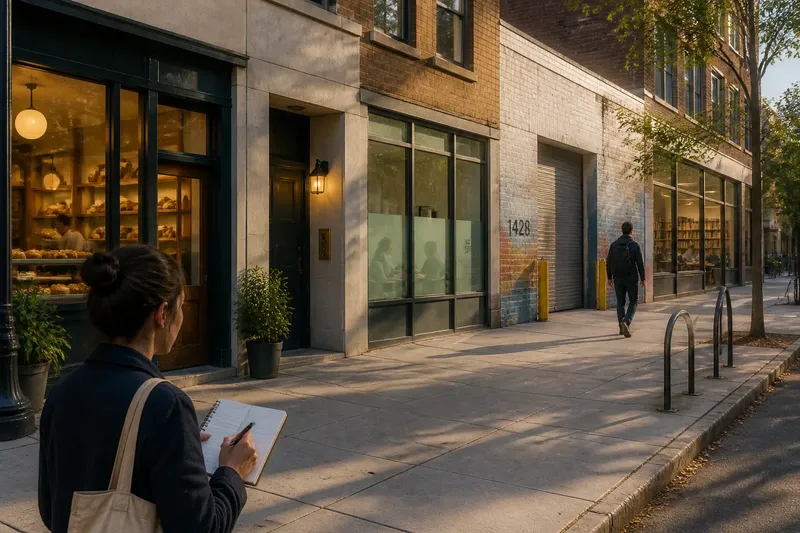
The common mistake on a slow block walk is to count doors and windows as if the façade were a list. That count misses how entrances, displays, and long walls change what a pedestrian can see from one stretch to the next. A careful pass gives you a description of those visible cues, not a verdict on how people feel or behave.
Say you are walking a fictional commercial block called Alder Street, from a corner grocery to a small public library. Along the way are shops, an apartment entrance, a clinic, and a service wall. Your task is to note what each ground-floor edge presents at sidewalk level and where that presentation changes.
What does a slow block walk record?
Treat the block as a sequence of frontages. A door may be identifiable by its handle, sign, or recessed entry. A window may reveal a display or activity inside, while a blank wall may offer little to read at eye level. Texture, a mural, a loading door, or a shadow can still make a wall’s surface distinct.
Walk from one corner to the next, keeping to the same side of the street. Make an ordinary pass, then a slower one. Use a pocket notebook to record short observations; a phone camera can help capture a detail, but the notes should explain what is visible rather than merely collect images.
On Alder Street, the first frontage is a bakery with a door beside a broad display window. Next is a residential entrance with a buzzer panel and narrow sidelight. A clinic follows, with glazing covered at eye level. Then comes a service wall broken by a loading door and painted address. The library finishes the route with several windows and a visible reading area.
How does a slow block walk compare frontages?
Pause when the ground-floor boundary changes. Ask what someone can identify from the sidewalk: where an entrance is, whether the window reveals activity or reflects the street, and what details are available along the wall. These observations keep the comparison tied to what is actually visible.
Write notes in plain language, such as “display beside recessed door” or “long wall with one address marker.” Avoid verdicts like “welcoming” or “hostile.” A small sketch can show where an entrance sits in relation to a window and where the material changes.
On Alder Street, the bakery offers a display, a door, and a glimpse of the counter. The apartment entrance concentrates its visible information at the buzzer panel. Covered clinic glazing reveals little at eye level; the loading door interrupts the service wall. The library’s windows make interior activity visible again. This is a sequence of observable differences, not a claim that every passerby notices them.
Think of the frontage as a page of text. A door, sign, or display works like punctuation; a long uninterrupted wall reads more like a continuous line. The analogy helps describe where visible details break up the edge, without making a wall inherently good or bad.
What can the walk tell you, and what can’t it?
The walk can show where an entrance is legible, where glazing reveals or conceals activity, and where the edge has few details at pedestrian eye level. It cannot establish how many people stop, whether a business is thriving, or why an owner chose a particular façade.
Keep looking and stopping separate in your notes. A display may be visible without drawing anyone inside; a recessed door may be easy to identify nearby but difficult to pick out from farther along the block. Record those features separately rather than treating one as proof of the other.
Temporary conditions also matter. A parked delivery vehicle, a loud conversation, glare, or a temporary sign may affect what you can see. Note the interruption, then distinguish it from the building edge. A quiet moment is not a permanent description of the block.
Which questions help explain what you noticed?
What counts as a blank wall?
For this walk, call a frontage visually blank when it offers few details at ordinary walking eye level. Note any texture, sign, door, or changing shadow rather than treating “blank” as an absolute category.
Should you count doors and windows?
Count them only if the number helps describe the sequence. Position and visibility may be more useful: one clearly marked entrance can be easier to read than several doors with no obvious public use.
How should you compare a shopfront and a private entrance?
Describe what each edge communicates from the sidewalk. A shopfront may present goods or a public entrance; a private entry may signal access for residents and invited visitors.
Can one walk show how everyone experiences a block?
No. It records what is visible from your route and how the frontage changes as you pass. People with different destinations, mobility, familiarity, or attention may read the same edge differently.
How can you apply the same notes elsewhere?
Imagine you walk a fictional second block with a café, an apartment entrance, and a long masonry wall. You note that the café has a street-facing display and a clearly marked door; the apartment entrance has a buzzer beside a recessed door; the wall has no sign or opening in the stretch you pass. Your resulting description is specific: the café presents two distinct cues, the private entry has one concentrated access point, and the wall offers few visible details. It does not claim that anyone stopped or chose to enter.
On another route, use the same questions and compare the order of cues rather than naming a winner. If an entrance is difficult to pick out, state why: it may blend into the wall, sit behind a display, or be obscured by a temporary object. That gives neighbors, property owners, and designers something concrete to discuss. A slow block walk describes the street edge; it does not solve it.