Why a Continuous Sidewalk Feels Easier to Follow
See how a continuous sidewalk stays clear across driveways, repairs, and corners, and identify which route break deserves attention first.
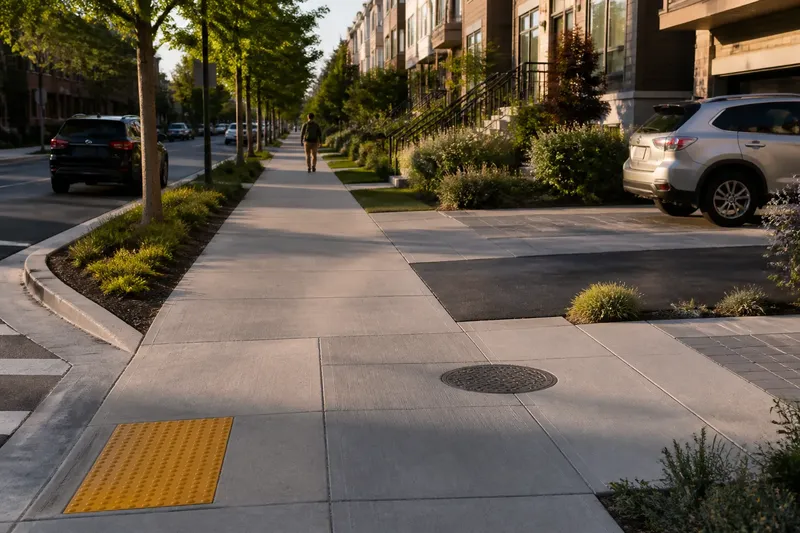
The common mistake is treating each sidewalk gap as a separate repair. That can leave the route technically present but hard to read, costing pedestrians attention at every driveway, patch, or change in level. A continuous sidewalk feels easier to follow because its surface and direction make one route legible from block to block.
What makes a sidewalk read as one route?
Continuity is both physical and visual. Physically, a person can keep moving without stepping into a vehicle path, negotiating an unexpected level change, or searching for a way around an obstruction. Visually, a consistent walking surface gives the eye a clear line to follow.
That line need not use identical paving everywhere. Concrete panels may meet asphalt at a driveway, and a curb ramp may change the texture. The question is whether those transitions still make the pedestrian route apparent. Think of a sidewalk like a sentence: a comma helps organize it, while a missing stretch leaves the reader guessing where it continues.
Is the main problem a physical break?
If the walking surface stops altogether, narrows sharply, or forces people into a driveway or roadway, physical continuity is the priority. A visible sidewalk on the far side does not resolve the interruption if a person cannot reach it along a clear, usable path.
Look for missing segments near corners, vacant lots, transit stops, and property entrances. Note whether a person can continue on the sidewalk without entering a space where drivers may be turning or backing. Also notice what happens to someone using a wheelchair, pushing a stroller, or carrying bags; a route that only works for a nimble pedestrian is not continuous in a useful sense.
If a segment is absent, identify a connection that preserves a clear pedestrian route through the gap. Where public and private property meet, the boundary may complicate responsibility, but it does not make the break disappear. Consider the route as a whole, including how it connects at both ends.
Does a driveway keep breaking the walking line?
If driveways are the main interruptions, focus on how the sidewalk crosses them. A sidewalk that rises and falls with each vehicle entrance can feel like a series of ramps rather than a path. A more legible arrangement keeps the pedestrian line visually and physically consistent while the driveway crosses it.
Check whether the walking surface remains easy to distinguish from the driveway, whether its slope changes abruptly, and whether turning vehicles have a clear place to cross it. Repeated material changes can make the pedestrian route seem to end at each entrance, even when the concrete continues.
For a block with many driveways, improving the shared pattern may help more than treating each entrance as an unrelated patch. That does not mean every driveway can be rebuilt in the same way; it means each transition should make clear that the sidewalk continues and that vehicles are crossing it.
Is the route hard to read because materials change?
If people can physically continue but the walking line fades at patches, utility covers, or changes in paving, the main issue is visual continuity. A surface does not have to be one color, but a pedestrian should be able to distinguish the path from adjoining areas without studying the ground.
Compare the sidewalk’s edges and surface before and after each transition. A patch that blends into the walking area may preserve the route better than a contrasting strip that resembles a boundary. Where a utility cover or repair cannot match the surrounding pavement, its placement and surrounding pattern can still keep the sidewalk’s direction clear.
A change in material can also be useful when it marks a real transition, such as a curb ramp or a different pedestrian zone. It becomes confusing when small, unrelated changes arrive in quick succession and offer no consistent cue about where to walk.
Do corners or curb ramps interrupt the route?
If the sidewalk reads clearly along the block but breaks down at intersections, inspect the corner as part of the same route. Curb ramps, landings, and connections to the opposite sidewalk need to form a recognizable path. A person should not have to infer which ramp leads toward the crossing or where the sidewalk resumes afterward.
Pay attention to alignment, surface transitions, and the place where the walking area meets the crossing. If a ramp directs pedestrians toward a different point than the marked crossing, the route can feel disjointed even when both features are present. Address the connection as a sequence, rather than polishing one corner element in isolation.
Specific requirements for curb ramps and accessible routes depend on applicable rules and project conditions; consult relevant local standards and a qualified design professional where needed.
Which sidewalk continuity issue should you address first?
Choose the condition that most directly interrupts a person’s ability to keep moving and understand where the path goes next. Check each condition below; the observation points to a practical next decision.
- The path disappears: If a segment is missing or forces a detour, identify a physical connection through the gap; if the route resumes nearby but no clear link exists, review how its ends can connect.
- Vehicles cross the walking line repeatedly: If several driveways interrupt the sidewalk, review their transitions as a corridor pattern; if one entrance is the outlier, focus attention there.
- The pavement is present but visually fragmented: If repairs or material changes obscure the walking line, make the route’s edges and direction clearer; if the path remains easy to trace, prioritize a different interruption.
- The route fails at the corner: If the sidewalk, ramp, and crossing do not align as a sequence, review their connection together; if they do, continue tracing the route beyond the intersection.
- The surface changes level abruptly: If the change makes continued walking difficult or sends people toward a vehicle path, address that transition first; if the level change is manageable and the line stays clear, inspect the next break.
- An obstruction narrows the route: If a pole, sign, or other object forces a detour, consider how the clear walking line can be restored; if people can pass without leaving it, record the obstruction and check the remaining route.
Say you are reviewing an invented block with continuous concrete between intersections, three driveways that slope sharply, dark asphalt across each entrance, and a corner ramp aligned with the marked crossing. First, trace the route and record that the path does not disappear. Next, compare the three driveways and note that the same slope and material change recur at each one. Then check the corner and find that its ramp and crossing form a clear connection. The resulting decision is to examine the repeated driveway transitions as the first corridor issue, rather than treating the corner as the problem. The observable aim is a walking line that remains distinct through the entrances; whether the transitions can be made alike depends on site conditions and applicable standards.
What questions help identify the right sidewalk continuity fix?
Can different paving still feel continuous?
Yes. Continuity depends on whether the route remains easy to trace and use, not on matching every material. A clear edge, steady alignment, and manageable transitions can connect surfaces that differ.
Should every sidewalk interruption be removed?
Not necessarily. Driveways, utility access, and curb ramps serve real functions; the goal is to make their crossings and transitions readable without making the sidewalk seem to vanish.
Where should a block review begin?
Start at one end and follow the walking line to the other, noting each place where a person must stop, change direction, or guess where the sidewalk continues. This makes isolated defects visible while showing whether several small breaks form one larger pattern.
What can make a continuous sidewalk feel awkward?
Look for abrupt changes in slope, narrow passages, or visual cues that point pedestrians toward a driveway or obstruction. A connected surface can still be difficult to follow if its direction is unclear.
How can a block keep the route clear?
Treat the pedestrian route as a connected piece of public space, even where driveways, repairs, and corners interrupt its surface. The useful improvement depends on whether the break is physical, visual, or concentrated at a transition; naming that distinction helps prevent a cosmetic patch from standing in for a usable connection.
To see why a continuous sidewalk feels easier to follow, trace the route at walking pace and ask whether its next segment is evident before you reach it. That simple check can reveal where a block needs a connection, a clearer transition, or less visual noise.