The Empty Lane Myth: More Road Space Does Not Explain Every Delay
An empty traffic lane can mislead; learn what to observe across signals, queues, turns, and time of day before judging what is causing delay.
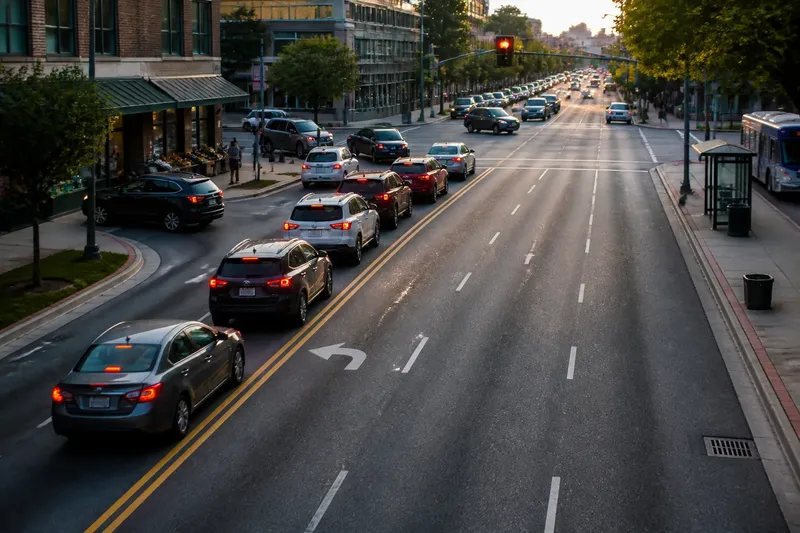
The common mistake in reading traffic is treating an empty lane as proof that a street has spare capacity. That can point attention toward adding road space when the delay actually begins at a signal, a turning vehicle, or a queue beyond view. An empty traffic lane is a momentary scene, not a diagnosis.
What does an empty lane tell you?
It tells you that few vehicles occupy that lane at that moment. It does not show how many vehicles will arrive next, whether the lane serves a particular movement, or how long traffic has been waiting elsewhere. A quiet curb lane may be used for parking, deliveries, buses, or turns rather than continuous through travel.
A lane that looks open may also be temporarily unusable. A vehicle could be preparing to turn, a bus could be approaching a stop, or a delivery could briefly block access. The visible pavement is only one part of the street’s working arrangement.
Think of a lane like an open checkout line: the queue you can see is not the only thing determining how quickly people get through. The cashier, the next arrival, and the line’s destination matter too. On a street, those details include vehicle arrivals, signals, turns, and what happens beyond the point you can see.
Where does the delay begin?
Look upstream and downstream from the open space. A queue may be held at a signal, narrowed by a loading vehicle, or backed up from a turn farther along the block. The lane in front of you can be empty because vehicles have not yet been released into it.
Notice where vehicles begin to slow and where they start moving again. If they bunch near an intersection and clear together, the signal may be setting the rhythm. If the line remains slow after the intersection, another constraint may lie farther along the route. Observations from more than one point are more useful than a single view from the curb.
Say you are looking at a block near a grocery store. The outside lane appears open at first. Across several signal changes, you notice cars waiting to turn into the store driveway while through traffic moves in short groups after the light. The visible pattern points to the turning queue as the place where movement is interrupted; it does not establish that more general road space would help.
How do signals and turns change the picture?
A signal divides movement into periods of release and waiting. An empty lane during a red phase may simply be waiting its turn. When the light changes, vehicles can arrive in a compact group, fill the lane, and clear before the next glance. Looking only at the quiet interval makes the street seem less used than it is across the signal cycle.
Turning traffic also uses space differently from through traffic. A car waiting to turn across oncoming traffic can hold up vehicles behind it, even when the adjacent lane appears open. That lane may not be a practical alternative if drivers cannot merge safely or if it serves a different movement. A turn lane can look underused between groups yet still give waiting vehicles somewhere to stand without blocking through travel.
Watch a location through several signal changes and note whether the same queue returns, where it begins, and which direction it serves. This is observation, not a traffic count. It helps distinguish a recurring pattern from a brief pause caused by an unusual arrival or maneuver.
What should you compare across time?
Traffic patterns vary with the purpose of a trip and activity around a block. A street near offices may carry a concentrated flow at the start or end of the workday. A school entrance, market, or bus stop can create short-lived clusters at other times. One quiet period does not describe the whole day, and one busy period does not describe every hour.
Compare similar places and conditions rather than treating every observation as interchangeable. Note the day type, general time, weather if it affects visibility or road use, and whether a nearby pickup or delivery is underway. The point is not to build an elaborate log; it is to avoid comparing a calm midday glance with a busy period and calling the difference a road-space problem.
Distinguish a recurring queue from one that appears only after an obstruction or unusual event. If the same delay returns in the same place, it deserves attention as a pattern. If it shifts around, the cause may vary, and a single infrastructure change may not address it.
Which questions clarify an empty lane?
Does an empty lane mean traffic is moving freely?
No. It may be between signal releases, separated from a queue by an intersection, or serving a different movement. Check what vehicles do before and after the open stretch.
Can one busy intersection make a whole street look congested?
Yes. A queue at one junction can extend into neighboring blocks and make the corridor appear slow. Watch where vehicles stop and whether they move freely once past that point.
Why might drivers leave a lane unused?
The lane may be a turn lane, bus lane, parking lane, or a route that is difficult to enter from the current position. Check signs and pavement markings before interpreting its use.
How long should you watch before drawing a conclusion?
No single observation period fits every street. Seeing several signal changes and revisiting at a meaningfully different time can help reveal whether a pattern repeats, without standing in for a full traffic analysis.
How should you record what you see?
Separate the visible condition, the location of the queue or pause, and whether it repeats. Record the direction of travel and the nearby feature involved, such as a signal, driveway, bus stop, or loading area. A concise note might say: “Westbound vehicles wait at the signal, clear in groups, then slow near the driveway.” That describes an observable sequence without claiming to know its cause.
- Check the lane markings and signs: If they identify a turn, bus, or parking lane, then assess it according to that use; otherwise, check nearby intersections and curb activity before treating it as a through lane.
- Check where the queue starts: If vehicles begin waiting at a signal, then observe their release; if the queue starts elsewhere, follow it toward the next turn, driveway, or obstruction.
- Check whether the lane stays open through a signal change: If it fills after the light changes, then note the release pattern; if it remains open, inspect whether its permitted movement or access differs.
- Check for turning vehicles holding traffic: If a turn blocks vehicles behind it, then note the turn’s location and direction; if not, look for a different point where vehicles slow.
- Check whether the same pause returns: If it recurs at the same place, then record it as a repeated pattern; if it shifts, note the changing condition rather than assigning one fixed cause.
- Check the context of each visit: If day, time, weather, or pickup activity differs, then keep those observations separate; if conditions are comparable, compare the locations and sequence directly.
The empty lane myth is not that open road space never matters. It is that a view of open pavement explains a delay by itself. For a sound reading of traffic, follow movement to where it slows, watch what changes after a signal, and compare the same place under different conditions. An empty traffic lane is a reason to ask what movement it serves and what is holding traffic elsewhere, not a verdict on how much road a street needs.